
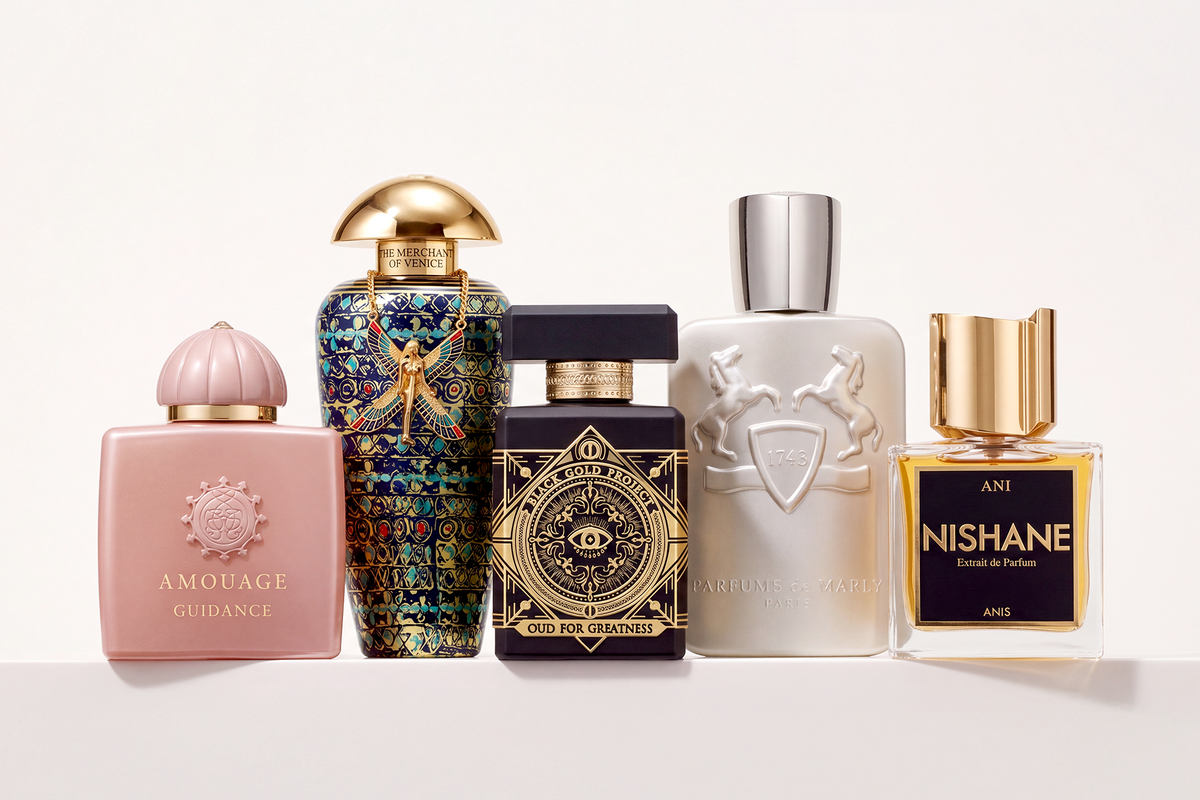

There's a particular kind of compliment that only comes from a scent nobody can quite place. Not "you smell nice" — but "what is that?" That's usually the tell-tale sign of someone who layers their fragrance rather than relying on a single spray from a single bottle, and it's a habit that's moved from niche perfumery circles into the mainstream over the past couple of years.
Fragrance layering — sometimes called fragrance combining or scent stacking — means wearing two or more fragranced products together to build a scent that's genuinely your own. It's not a new idea, but it's having a proper moment: 2026's fragrance trends point firmly towards personalisation, with more people mixing, matching and building bespoke-style scent wardrobes rather than sticking to one signature bottle.
The good news is that you don't need a perfumer's nose or a cabinet full of niche fragrance to do it well. You just need to understand a few basic rules.
What is fragrance layering?
Fragrance layering is the practice of combining two or more scented products — usually two perfumes, or a perfume with a complementary body product such as a shower gel, body lotion or candle — to create a new, more complex scent profile than either would give you alone.
Done well, it can make a fragrance feel more distinctive, help a scent last longer on your skin, and let you adapt one core perfume for different seasons or occasions simply by changing what you layer underneath or over it.
Why layer your fragrance?
A few reasons this has become such a popular way to wear perfume:
It makes your scent harder to place. When you wear a fragrance exactly as it comes out of the bottle, you're smelling identical to everyone else who bought that bottle. Layering shifts the balance just enough that it reads as personal rather than off-the-shelf.
It can extend how long a fragrance lasts. Building scent in layers — through a matching shower gel or body lotion, for example — gives the fragrance more surface area and more oil-based product to cling to, which typically means better longevity than a single spray on dry skin.
It's a more accessible route to a "custom" scent. Bespoke perfumery is a genuine luxury experience, but it comes with a price tag to match. Layering two or three fragrances you already own, or building a considered edit over time, gets you somewhere similar for a fraction of the cost.
It lets one fragrance do more. A single Eau de Parfum can feel like several different fragrances depending on what you pair it with — brighter and fresher layered with something citrus-led, warmer and cosier layered with something spicy or woody.
The rules of fragrance layering
Before you start combining bottles at random, a few principles are worth knowing.
Stick to the same fragrance family, at least at first. Every fragrance sits broadly within a family — floral, woody, oriental/amber, fresh, gourmand and so on. Two scents from the same or closely related families are far more likely to sit well together than two that pull in completely different directions. [The Fragrance Wheel Explained] is a useful primer if you want to understand how these families relate to one another before you start experimenting.
Layer light to heavy. Apply the lighter, fresher fragrance first and let the richer, heavier one sit on top — not the other way round. A heavy amber or oud-based scent applied first will usually overpower a lighter floral or citrus layered afterwards.
Less is more. Layering isn't about doubling the amount of fragrance you wear. One or two sprays of each element is usually enough — you're aiming for a new blend, not a wall of scent.
Test on skin, not just in the air. Fragrance behaves differently on your own skin chemistry than it does straight from the bottle. Spray your combination on pulse points and wait at least ten to fifteen minutes before judging whether it works, as top notes fade and the true blend only settles in after a while.
Patch test if your skin is sensitive. If you know your skin reacts easily to new products, apply a small amount of any new fragrance to an inconspicuous area first and wait 24 hours before layering it more widely. If you notice any irritation, stop use and speak to a pharmacist or dermatologist.
How to layer fragrance, step by step
- Start with clean, slightly damp skin. Fragrance holds better on moisturised skin than dry skin, so apply straight after a shower if you can, or use an unscented or lightly scented body lotion as your base.
- Apply your base layer first. This is typically the lighter or fresher of your two fragrances, or a scented body product such as a shower gel or lotion in a complementary scent.
- Add your main fragrance over the top. Focus on pulse points — wrists, the base of the throat, behind the ears — where body heat helps the fragrance develop.
- Consider a third layer for special occasions. A scented candle or reed diffuser from the same or a related fragrance family in the room you're getting ready in can tie the whole effect together, though this is optional rather than essential.
- Give it time before deciding. Don't judge the combination in the first five minutes. Let the top notes settle and check back in after twenty minutes or so.
Fragrance families that work well together
As a general starting point for pairing:
- Floral with musk or soft woods tends to feel elegant and wearable, rounding out a floral's sweetness with something quieter underneath.
- Woody with spicy notes — think cedar or sandalwood with cardamom, pepper or clove — is a natural pairing for autumn and winter, and reads as warm without being overwhelming.
- Citrus with light florals keeps things fresh and versatile, and works well as a base layer under something heavier for evening.
- Gourmand (vanilla, caramel, praline) with warm woods is one of 2026's stand-out trends, giving classic dessert-inspired scents more depth and less sweetness.
These are starting principles rather than fixed rules — the best way to know if a combination works is to try it.
Brands built for layering

Some fragrance houses have built layering into their entire concept rather than treating it as an add-on. Jo Malone London is the best-known example: the brand actively encourages customers to combine its colognes to create a personal blend, describing the practice as "fragrance combining" across its own guidance. Many of its scents span multiple formats — cologne, candle, diffuser, body lotion or body crème in the same fragrance — which is what makes the "base layer plus fragrance" method described above so easy to put into practice with this brand specifically.
Beyond Jo Malone, look out for any fragrance house that offers a scent across multiple formats — Eau de Parfum, body lotion, shower gel or a matching candle — as these are typically formulated to complement one another.
A few starting points, by fragrance family
If you'd rather build a combination from your own choices than follow a matched set, here's how to think about it by family.
- Warm and spicy for autumn: look for a spiced-leather or amber-forward Eau de Parfum as a base layer for daytime, or worn alone for evening. Popular options are Tom Ford Ombre Leather or Armani Stronger with you Amber
- Gourmand, done with restraint: this is one of 2026's stand-out trends, and it spans a wide price range. Lattafa Khamrah Eau de Parfum Spray 100ml is a currently-listed cinnamon-and-vanilla example at an accessible price point — a good illustration of how this style of layering doesn't have to mean a luxury spend, though do reconfirm stock before linking it live.
- Musk as a base layer: a clean, understated musk works well as an unobtrusive base under a more distinctive floral or spiced fragrance on top. Our customers love Narcisco Rodriguez For Her PURE MUSC and BORNTOSTANDOUT Filthy Musk
- A floral to build around: a rounded floral Eau de Parfum takes well to a lighter citrus layered underneath, or a soft musk on top. You can't beat the bestsellers that are Prada Paradox and Armani My Way
Common fragrance layering mistakes to avoid
Combining scents from opposing families. A sharp, aquatic fragrance and a heavy, resinous oriental rarely sit well together — the contrast tends to read as confused rather than complex.
Overdoing the application. More sprays doesn't mean more sophistication. It's easy to tip into overwhelming territory, particularly in enclosed spaces like offices or cars.
Ignoring the occasion. A heavily layered, oud-rich combination that's perfect for an evening out may not be the right choice for the office. Build a couple of different combinations for different contexts rather than relying on one.
Not testing before you commit. Always try a new combination on skin before wearing it somewhere important — what smells good in the first sixty seconds can develop very differently after twenty minutes.

Layering vs a single signature scent vs bespoke perfumery
If you're weighing up whether layering is the right approach for you, here's how it compares with the two alternatives:
| Single signature scent | Fragrance layering | Bespoke perfumery | |
|---|---|---|---|
| What it is | Wearing one fragrance, as sold | Combining two or more fragranced products to build your own blend | A fragrance created specifically for you, usually with a perfumer |
| Cost | One bottle | Typically two or more products, but can start small (a cologne plus one other format) | Significantly higher — a genuine luxury service |
| Distinctiveness | Identical to everyone who buys that bottle | More personal, though still built from recognisable fragrances | Entirely unique to you |
| Effort required | None once purchased | Some trial and error to find combinations you like | Minimal effort, but requires a consultation process |
| Best suited to | Anyone who's found a scent they love and wants simplicity | Fragrance-curious shoppers who want to experiment without a big commitment | Those who see fragrance as a considered, one-off investment |
Building your own layering wardrobe at allbeauty

You don't need to overhaul your fragrance collection overnight. A good starting point is one warm, spice or wood-led Eau de Parfum for the base of an autumn layering routine, alongside a lighter, fresher scent you can wear underneath it or on its own. Browse Women's Eau de Parfum and Men's Eau de Parfum to find pieces from houses including Tom Ford, Hermès, Amouage, Xerjoff and Yves Saint Laurent, or explore our Niche Fragrance collection if you want something with more distinctive, less mainstream character to build around.
If you'd rather try a considered edit in one go, allbeauty's Fragrance Gift Sets often bundle a fragrance with a complementary body product — a genuinely practical way to start layering without buying two full-size bottles at once. And if you want the simplest possible starting point, Jo Malone's matched cologne-and-candle or cologne-and-lotion scents take the guesswork out of matching formats entirely.
Fragrance layering rewards a bit of patience and a willingness to experiment, but the payoff is a scent that's genuinely yours rather than one shared with everyone who bought the same bottle. Start with two fragrances from a similar family, apply light to heavy, and give yourself time to judge the result before deciding it's not for you.
Discover the fragrance collection at allbeauty and start building a scent wardrobe worth layering.
FAQS
Can you layer two different perfumes together? Yes. The key is choosing fragrances from the same or closely related families — two florals, or a woody and a spicy scent, for example — rather than combining scents that pull in very different directions.
Does fragrance layering make perfume last longer? It can help. Building scent through a matching body product underneath a perfume, or applying to moisturised skin, generally improves how long a fragrance lasts compared with a single spray on dry skin, though individual skin chemistry always plays a part.
What's the correct order to layer fragrance? Apply the lighter, fresher scent first, followed by the heavier or richer fragrance on top. This stops the lighter scent from being completely overpowered.
Is fragrance layering the same as buying a bespoke perfume? No. Bespoke perfumery involves a fragrance created specifically for you, usually with a perfumer, at a significant cost. Layering is a more accessible way to personalise fragrances you already own or can buy off the shelf.


