

More people are asking, openly, why their hair seems to be shedding more than it used to. It's turning up in conversations that didn't used to include hair — at the hairdresser, with a GP, between friends comparing notes on shower drains. Some of that shift is coming from a much more open, mainstream conversation about GLP-1 weight-loss medications and their side effects, which has pulled hair shedding out of a topic people used to deal with quietly and into one people are actively researching and discussing.
If that's brought you here, the first thing worth knowing is that noticing more shedding doesn't automatically mean something is seriously wrong. It's also not something a serum alone will necessarily fix, if there's a real cause underneath it. Here's what's normal, what GLP-1 medication, stress or a hormonal shift can actually do to your hair, and where a considered routine genuinely helps.
Shedding is normal. More shedding usually has a reason.
Everyone sheds hair constantly as part of a normal growth cycle — the American Academy of Dermatology puts normal daily shedding at somewhere between 50 and 100 hairs for most healthy people. What's being talked about more right now is a noticeable jump above that, a pattern dermatologists call telogen effluvium: a temporary, diffuse increase in shedding, triggered by some kind of stressor to the body, that typically doesn't show up until two to three months after the trigger itself. That delay is part of why it can feel confusing — the cause and the visible shedding rarely line up in people's minds.
This is different from patterned or permanent hair loss, and in most cases it does settle down once the underlying trigger resolves. But "temporary" isn't the same as "ignorable," and a two-to-three-month lag means it's worth thinking back rather than just treating the symptom.

The causes getting more attention right now
Stress. Significant physical or emotional stress — illness, surgery, bereavement, a major life change — is a recognised trigger for this kind of shedding. It's generally a substantial event rather than an ordinary stressful week, and the shedding shows up months later, which is often what makes people struggle to connect the two.
Hormonal change. Shifts in hormones — around menopause, postpartum, thyroid conditions or PCOS among others — are well-established triggers for increased shedding. This is one of the more common reasons hair thinning becomes noticeable at particular life stages rather than gradually over time.
Rapid or significant weight loss. A fast or substantial drop in weight, however it happens, is itself a recognised trigger for telogen effluvium — the body treats it as a significant physical stressor, in the same broad category as illness or surgery.
GLP-1 medication. This is the piece that's genuinely new to the conversation. Hair shedding associated with GLP-1 medications such as semaglutide and tirzepatide has become the subject of active clinical research and coverage over the past year, including a peer-reviewed systematic review. What isn't yet fully settled is the exact mechanism — whether it's an effect of the medication itself, or a consequence of the rapid, significant weight loss the medication often produces, which is already a known trigger in its own right. Either way, if you're on a GLP-1 medication and noticing more shedding than usual, it's worth raising with the clinician who prescribed it rather than assuming a haircare routine alone will resolve it.
What a routine can actually do — and what it can't
This is the part worth being honest about. Haircare products and supplements can support the condition of the hair you currently have and the health of your scalp — strengthening strands against breakage, supporting a healthier-feeling scalp, improving how thinning hair looks and behaves day to day. What they can't do is treat an underlying hormonal condition, reverse a medication side effect, or replace a conversation with a GP, dermatologist or trichologist if that's genuinely what's needed. If shedding is sudden, heavy, patchy or shows no sign of settling after a few months, that's a "go and get it looked at" situation, not a "try a new shampoo" one.
With that said, if you're dealing with the everyday version of this — thinner-feeling hair, a bit more shedding than you'd like, wanting to support your hair and scalp while any underlying cause resolves or gets addressed — there's a genuine, considered routine worth building.
Building a routine around it
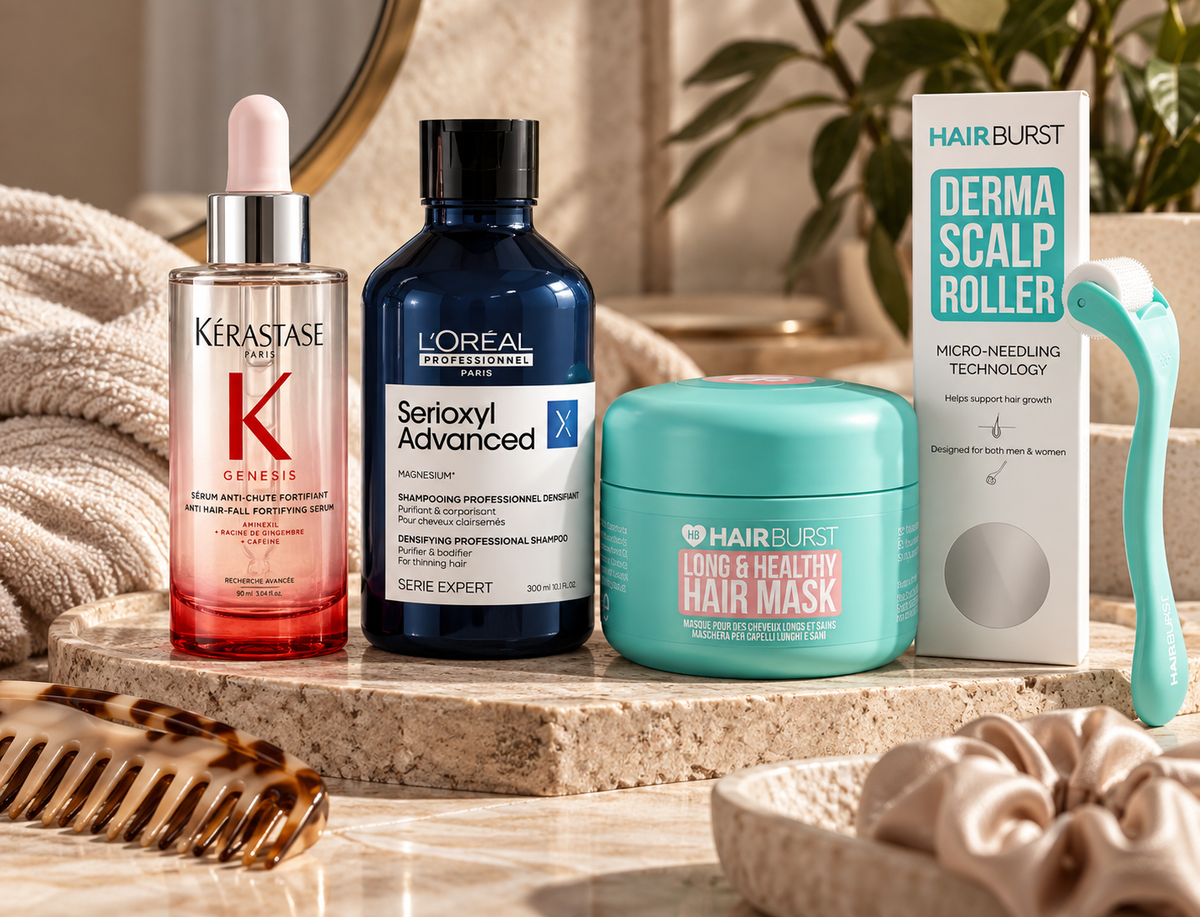
Start at the root, with a targeted serum. Kérastase Genesis Anti-Chute Fortifiant Nourishing & Fortifying Serum. Genesis is Kérastase's range built specifically around hair that's already showing signs of weakness or fall. Kérastase's own usage directions call for it to be applied directly to a dry or towel-dried scalp rather than through the lengths, making it a sensible first step for anyone noticing more shedding than usual.

Swap in a shampoo built for the same concern. L'Oréal Professionnel Serie Expert Serioxyl Advanced Purifier & Bodifier Shampoo is part of the Serioxyl collection from L'Oréal Professionnel's dedicated thinning-hair range, and this shampoo is designed to purify the scalp and add body at the root. It's currently showing as low stock, so worth checking availability before committing to it specifically.

Follow with a denser-hair treatment. L'Oréal Professionnel Serioxyl Advanced Denser Hair Serum for Thinning Hair pairs naturally with the shampoo above as a two-step system from the same range. This one is also showing low stock at the time of writing. Worth noting: this sits in the "improve the look and feel of thinning hair" category rather than a bond-repair product — bond repair addresses a different problem (chemically or heat-damaged hair shafts), and isn't really what applies to hair-loss-related thinning, so it's been left out of this routine deliberately rather than added for the sake of ticking a box.
Add a weekly mask for overall condition. Hairburst Long & Healthy Hair Mask is a general strengthening and conditioning mask rather than a thinning-specific formula, built around coconut, sunflower seed, argan and avocado to minimise breakage and improve manageability — a genuinely useful weekly step for hair that's more fragile than usual, even if it isn't targeting shedding directly.

Consider a supplement, where it's genuinely relevant. Vitabiotics Menopace Original Tablets x 90 are specifically formulated to support the menopause transition rather than being a general hair-growth supplement, so it belongs here for readers whose shedding is tied to that particular hormonal shift — not as a catch-all recommendation for anyone experiencing hair loss. It's currently showing as low stock, so worth checking availability before committing to it specifically.
Or address the scalp directly. Hairburst Derma Scalp Roller Micro-Needling for Thinning Hair is a Micro-needling tool designed to be used on the scalp to support the look of thinning areas, and suit anyone who'd rather add a hands-on step to their routine than another bottle.
Building this routine at allbeauty
Behind every product in this line-up is a buying team whose job is to track down genuinely relevant formulas — from established salon names like Kérastase and L'Oréal Professionnel to more targeted, concern-specific brands like Hairburst and Vitabiotics — and bring them to you at a properly competitive price. It's the same approach across the rest of allbeauty's haircare range, so once you've addressed what's actually causing your shedding, it's worth a proper look at what else is there to support the hair you're growing back.
Explore allbeauty's thinning hair range to build your routine.
FAQs
Is hair shedding the same as hair loss? Not necessarily. Everyone sheds hair as part of a normal cycle — the American Academy of Dermatology puts typical daily shedding at somewhere between 50 and 100 hairs for most healthy people. What's being talked about more now is a noticeable jump above that, often temporary, called telogen effluvium. It's different from patterned or permanent hair loss, though it can feel just as alarming to notice.
Can stress really cause hair loss? Yes. Significant physical or emotional stress is a recognised trigger for temporary increased shedding. It's usually a substantial event — illness, surgery, a major life change — rather than everyday stress, and the shedding typically doesn't show up until two to three months afterwards.
Does GLP-1 medication cause hair loss? It's an association that's being taken seriously and is currently the subject of active clinical research, though there's still some uncertainty about the exact mechanism — whether it's the medication itself or the rapid, significant weight loss it can cause, which is a separately recognised trigger. If you're on a GLP-1 medication and noticing increased shedding, it's worth raising with the prescribing clinician rather than assuming a haircare routine alone will address it.
How long does this kind of hair shedding usually last? According to the Cleveland Clinic, telogen effluvium typically lasts around three to six months from when it starts, and once the underlying trigger has resolved, most people begin to see new regrowth within a similar three-to-six-month window — though it can take six to eight months in total for things to fully settle. Everyone's timeline differs, and if it's dragging on well beyond that, it's worth getting checked rather than waiting it out indefinitely.
Is it safe to use a hair or scalp routine alongside a GLP-1 medication? I'm not aware of any specific research on this, so treat this as general reasoning rather than a sourced medical answer: the products in this routine are applied topically to the hair and scalp, or in Menopace's case are a menopause-specific supplement, rather than being medications in their own right, so there's no obvious mechanism for them to interact with a GLP-1 medication. That said, it's always sensible to mention any new supplement — including Menopace — to whoever prescribes your treatment, and to raise any shedding you're experiencing with them directly rather than assuming a routine alone will resolve it.
When should I see a doctor about hair loss? If shedding is sudden, heavy, patchy, or accompanied by scalp changes or other symptoms, or if it isn't settling after a few months, it's worth speaking to a GP, dermatologist or trichologist rather than relying on routine changes alone. They can identify or rule out an underlying cause and advise on treatment a retail routine can't provide.
Can supplements or haircare products regrow lost hair? They can support the condition of the hair and scalp you currently have, but they don't address underlying medical causes such as hormonal shifts, thyroid conditions or medication side effects. If there's an underlying cause, that needs addressing separately — with a GP or specialist — for a routine to make the difference you're hoping for.
