
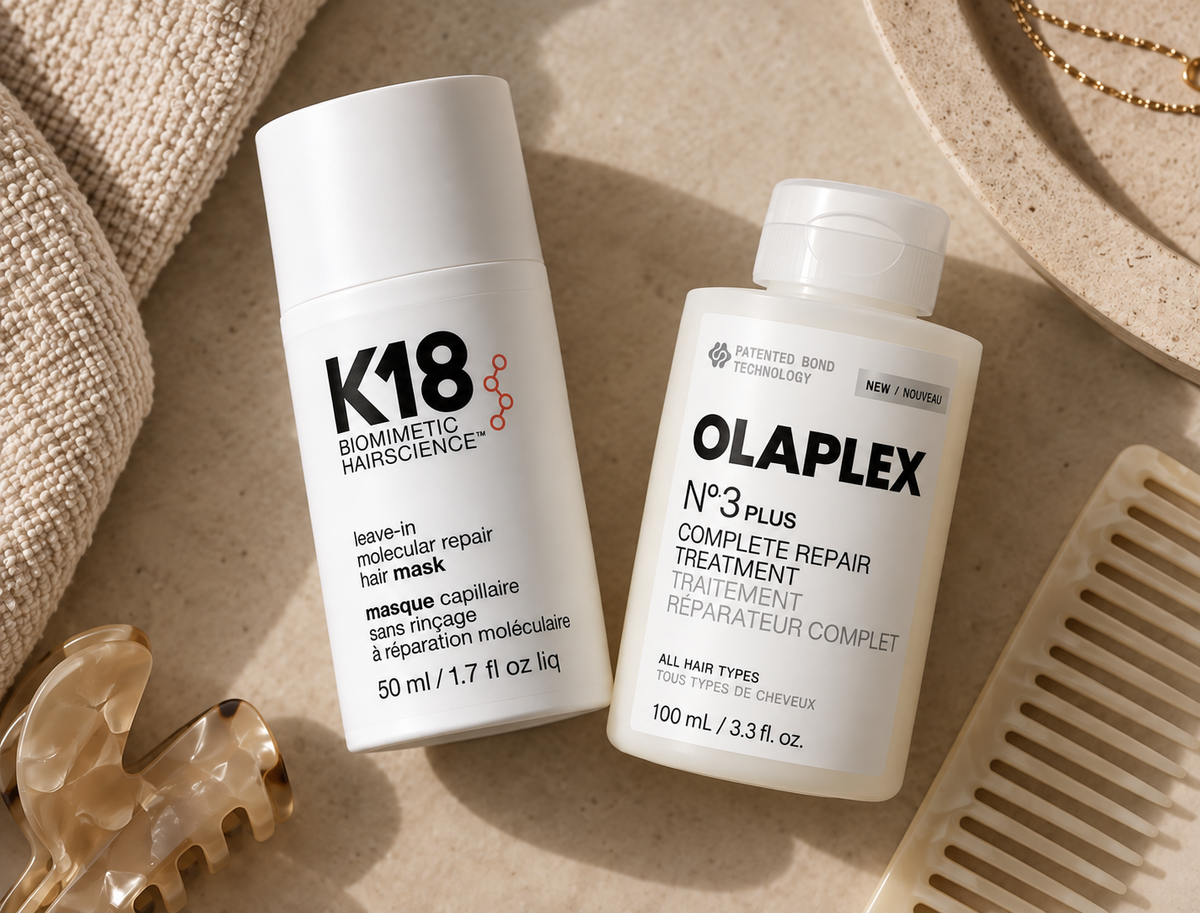

If you've spent any time researching damaged hair, you've come across both of these names, usually mentioned in the same breath, usually with someone insisting one is "so much better" than the other. It's rarely that simple. K18 and Olaplex approach hair repair in genuinely different ways, and which one is right for you depends more on your hair, your routine, and what you're trying to fix than on which brand has the louder following.
Here's the short version: K18's Leave-In Molecular Repair Hair Mask is a four-minute, no-rinse step built around a single patented peptide, and it's usually the easier product to fit into an existing routine. Olaplex's No.3+ Repair Treatment is an in-shower, pre-shampoo treatment built around a patented bond-building ingredient, and it's the more established choice for seriously chemically processed or bleached hair. Plenty of people end up using both, for different reasons, which we'll get to.
What K18 actually claims to do

K18's technology is built around a single ingredient, K18PEPTIDE™, which the brand describes as a biotechnology-derived molecule engineered to "match and click into hair's keratin structure, reconnecting damage sites at the molecular level." According to K18's own science pages, it targets multiple bond types within the hair, including the polypeptide chains and disulfide bonds broken down by bleaching, colouring, chemical treatments and heat.
The headline claim is speed and simplicity: K18 says results are visible "from the very first application," in "just four minutes, with no extra steps," left in rather than rinsed out. That's the core of its appeal — one product, one short step, folded into a routine you're probably already doing.
What Olaplex actually claims to do

Olaplex's approach starts from a different problem. According to the brand's own science pages, hair damage happens when disulfide bonds break during chemical treatment, heat styling or general mechanical stress, and once broken, those bonds struggle to reform on their own. Olaplex's patented active ingredient, Bis-Aminopropyl Diglycol Dimaleate, is designed to "link broken disulfide bonds in the hair on a molecular level," which the brand says makes bonds more durable and damage "both reversible and preventable."
Olaplex frames this as working the same way across all hair types, since at a molecular level, as the brand puts it, "all hair is the same, no matter its texture or integrity." In practice, this is the technology and the multi-step system that built Olaplex's reputation with colourists and people with heavily bleached or chemically processed hair.
How they're actually used, day to day
This is where the practical difference really shows up.
K18 is a leave-in. You apply it to damp, towel-dried hair, work it through, and leave it — no rinsing, no waiting around, no extra step before you style. It's designed to slot into a routine you already have.

Olaplex's No.3+ Repair Treatment is a pre-shampoo, in-shower treatment. You apply it to dry or towel-dried hair before you shampoo, leave it on for a set time (check the product's own instructions, since timing can vary slightly by formula), then rinse and continue with your normal wash. It's an extra step, done regularly rather than daily, as part of a considered routine rather than a quick fix.
Neither approach is objectively better. If you're the kind of person who abandons a five-step routine within a fortnight, K18's one-step format is far more likely to actually get used. If you're already committed to a proper wash-day routine and want a treatment that sits within it, Olaplex's system fits naturally.
Who each one genuinely suits
K18 tends to suit you if: you want a low-effort addition to an existing routine, you have fine, dry or frizzy hair that doesn't need an intensive intervention, or you've been put off bond-repair treatments before because they felt like too much admin.
Olaplex tends to suit you if: you have severely bleached, colour-treated or chemically processed hair and want an established, multi-step system built specifically for that level of damage, or you're already following (or want to build) a considered wash-day routine rather than a single quick step.
Neither brand markets itself as exclusively for one hair type, and both claim broad suitability. This is a genuine case where routine fit matters as much as hair type: the "better" product is the one you'll actually use consistently.
Can you use both?
Yes, and plenty of people do, since they work through different mechanisms rather than doing the same job twice. A common approach is an Olaplex in-shower treatment as part of a weekly or twice-weekly wash-day routine, with K18's leave-in used more frequently, or after heat styling specifically. There's no strong reason to avoid combining them, though there's also no need to feel you must buy both to see a benefit from either — start with the one that matches your bigger concern (routine fatigue versus depth of damage), and add the other later if you want to.
Building a full routine with either brand
Both brands sell beyond their single hero product, and if you're committing to one system properly, the supporting products are worth knowing about.
Building a K18 routine: alongside the Leave-In Molecular Repair Hair Mask (also available as a 15ml try-it size), K18's Peptide Prep Detox Shampoo is designed as a clarifying first step that preps hair before other treatments work on it, and the Damage Shield pH Protective Shampoo is a gentler, everyday option for between treatments. If heat styling is a big part of your routine, the HeatBounce Conditioning Heat Protectant is worth adding specifically for that, and the AstroLift Reparative Volume Spray is a styling-focused option if volume and lift matter to you alongside repair.
Building an Olaplex routine: the No.3+ Repair Treatment (available in a 100ml size if you want to try it before committing to the 250ml bottle) is the core step, paired with the No.4 Bond Maintenance Shampoo and No.5 Bond Maintenance Conditioner for everyday washing that supports rather than undoes the bond-building work. The No.7 Bonding Oil, 30ml is a leave-in finishing step for shine and frizz control that works well alongside the wash-day system rather than replacing any part of it.
Price and format at a glance
| K18 Leave-In Molecular Repair Hair Mask | Olaplex No.3+ Repair Treatment | |
|---|---|---|
| Format | Leave-in, no rinse | In-shower, pre-shampoo, rinse out |
| Application time | 4 minutes | Around 10 minutes (check pack instructions) |
| Try-it size | 15ml — £27.55 (RRP £30.00) | 100ml — £23.95 (RRP £32.00) |
| Full size | 50ml — £52.50 (RRP £70.00) | 250ml — £45.85 (RRP £64.00) |
| Best for | Fitting into an existing routine with minimal extra effort | Considered wash-day routines, heavier chemical damage |
At full size, K18's mask costs £52.50 against Olaplex's £45.85 for the larger No.3+ Repair Treatment bottle — not identical, but in the same bracket, a £6.65 difference. At try-it size, the two sit even closer together: £27.55 for K18's 15ml against £23.95 for Olaplex's 100ml. Prices shown are correct as of 14 September 2026 and should be checked again before publish.
The honest answer
If you want the simplest possible answer: try the one that matches how you actually look after your hair, not the one with the louder social following. A single leave-in step tends to win out for busy routines; a proper in-shower system tends to win out for hair that's had a harder time of it chemically. Used well, either one is a genuine step up from doing nothing — and used together, they're not working against each other.
Behind both ranges is a buying team whose job is to go and find them: tracking down the haircare brands worth stocking, from established professional names like these to newer arrivals, and working to bring them to you at a genuinely competitive price rather than the full asking rate. It's the same approach across everything allbeauty stocks, from skincare to fragrance, so once your bond-repair routine is sorted, it's worth seeing what else is waiting for you.
Explore the full K18 range or the Olaplex range at allbeauty to find your bond-repair match.
FAQS
Is K18 or Olaplex better? Neither is objectively better — they work through different mechanisms and suit different routines. K18 is a single leave-in step designed for ease of use; Olaplex is a multi-step, in-shower system more associated with heavily chemically processed hair. The better choice is the one that fits your hair's needs and your actual routine.
Can I use K18 and Olaplex together? Yes. They aren't designed to compete for the same step in your routine, so many people use an Olaplex in-shower treatment as part of their wash-day routine alongside K18's leave-in for more frequent use. You don't need both to see a benefit from either.
Which is better for bleached hair? Olaplex has the longer track record specifically with heavily bleached and chemically processed hair, and its multi-step system was built with that level of damage in mind. K18 also markets itself as suitable for chemically treated hair, but with a lighter, single-step approach.
How quickly do K18 and Olaplex work? K18 states results are visible from the first application, with a four-minute application time. Olaplex's in-shower treatment takes longer per use and is typically part of a regular routine rather than a one-off fix, with cumulative results building over consistent use.
How often should I use K18 or Olaplex? K18's own guidance suggests once or twice a week for the leave-in mask, depending on how much repair your hair needs, with once weekly typically enough once hair is in better condition. Olaplex's guidance for No.3+ Repair Treatment varies by hair condition: once weekly or once every other week for healthy or virgin hair, once weekly for colour-treated hair, and up to two to three times a week for hair that's more heavily compromised. Neither is designed for daily use.
Do I need the full K18 or Olaplex system, or just the main product? No. Both hero products — K18's Leave-In Molecular Repair Hair Mask and Olaplex's No.3+ Repair Treatment — work as standalone treatments. The shampoos, conditioners and oils in each range support the main treatment and prevent everyday washing from undoing its work, but they're an addition, not a requirement.
