

K-beauty has been having a moment for long enough now that "moment" almost undersells it. But scroll past the trend pieces and the ten-step routine explainers on TikTok, and there's a question most of them skip: which brands are actually worth your money?
That's a fair thing to want answered. K-beauty isn't one philosophy or one product line — it's dozens of brands with genuinely different specialities, price points and approaches, and treating them as interchangeable does nobody any favours. So rather than another step-by-step routine, this is about four specific brands worth knowing, what each one actually does well, and where to start if you want to try one.
At a glance: which K-beauty brand suits you
| Brand | Best known for | Start with | Who it suits |
|---|---|---|---|
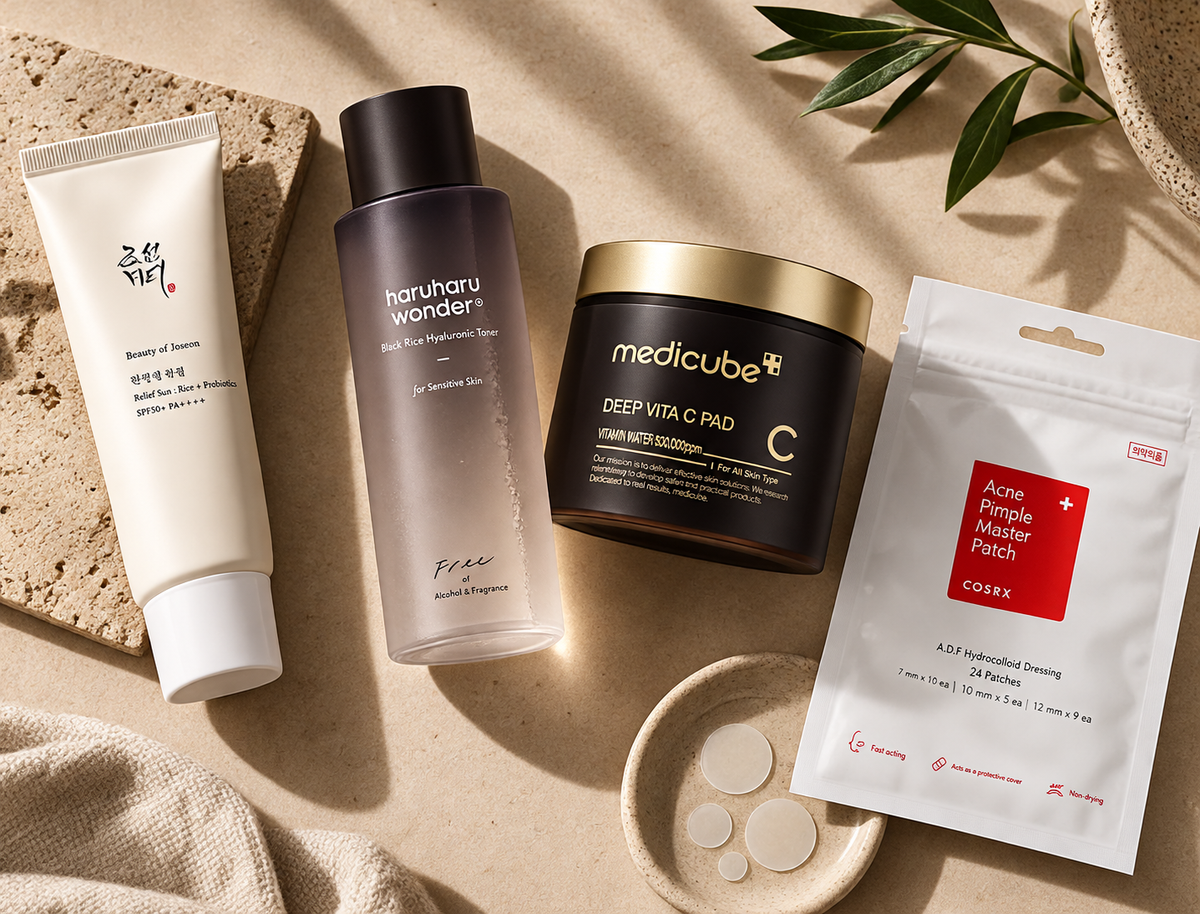
| Beauty Of Joseon | Traditional Korean ingredients (rice, ginseng) in everyday formulas | Relief Sun SPF50+ PA++++ | Anyone wanting a lightweight, no-white-cast daily sunscreen |
| Haruharu Wonder | Gentle formulas built around fermented black rice | Black Rice Hyaluronic Toner | Sensitive or easily-reactive skin that wants a soft hydration step |
| Medicube | Skincare-tech led brand, strong in pad and serum formats | Deep Vita C Pads or Zero Pore Mild Pads | Anyone wanting visible, targeted results without extra steps |
| Cosrx | Minimalist, single-ingredient, single-job treatments | Acne Pimple Master Patch | Anyone wanting one specific product, not a full routine |
What makes K-beauty different, in short
Korean skincare tends to favour layering lighter, more targeted formulas over one or two heavy-duty products, with a strong emphasis on hydration and prevention rather than treating problems once they've shown up. Ingredients like centella asiatica, fermented rice and propolis turn up constantly, chosen for being gentle enough for daily, repeated use. None of that means you need to overhaul your entire routine to get something out of it — even one well-chosen product, added to what you already do, is a reasonable way in.
Beauty of Joseon: the one to start with if you only try one

Beauty of Joseon has built its reputation on pairing traditional Korean "hanbang" ingredients, think rice, ginseng and mugwort, with straightforward, unfussy formulas. It's the most complete range of the four brands here, with genuine depth across sun protection, serums and moisturisers.
Its sunscreen, the Beauty Of Joseon Relief Sun: Rice + Probiotics SPF50+ PA++++, is the product most responsible for the brand's reputation, consistently trends on social media, and it's a reasonable place to start: a lightweight, non-greasy formula that sits well under makeup, without the heavy or white-cast finish some sun creams leave behind. If congestion or dullness is more your concern, the Beauty Of Joseon Glow Serum with Propolis & Niacinamide combines propolis extract with niacinamide to help balance oil and calm visible redness, and layers easily under a moisturiser. For that final hydrating step, the Beauty Of Joseon Dynasty Cream uses rice bran water, ginseng root water and squalane in a lightweight, quick-absorbing formula suited to normal-to-dry skin.
Haruharu Wonder: gentle formulas built around fermented black rice

Haruharu Wonder is a smaller range than Beauty of Joseon, but it has one genuinely standout product: the Haruharu Wonder Black Rice Hyaluronic Toner, an essence-style toner built around fermented black rice extract and hyaluronic acid, designed to be patted in straight after cleansing to prime skin for whatever comes next. It's currently showing as low stock on allbeauty, so if it appeals, it's worth checking availability rather than waiting.
For anyone dealing with dark spots or post-blemish marks, the brand's Haruharu Wonder Centella 4% TXA Dark Spot Go Away Serum pairs centella asiatica with tranexamic acid, an ingredient increasingly used in targeted brightening formulas, though as with any active ingredient, it's worth patch-testing first and checking with a pharmacist or dermatologist if you have sensitive or reactive skin.
Medicube: the one leaning into skincare technology

Medicube positions itself a little differently from the other three, combining more conventional skincare with a technology-led angle (the brand also makes at-home skincare devices, though those sit at a very different price point to everything else in this piece). Where it earns its place here is in its pad and serum formats, which suit anyone who wants visible, targeted results without adding several new steps to a routine.
The Medicube Deep Vita C Pads are a two-sided exfoliating and brightening pad aimed at uneven tone, while the Medicube Zero Pore Mild Pads are built around PHA rather than a stronger acid combination, and are specifically formulated for sensitive, easily-flushed skin — genuinely the gentler of Medicube's two "Zero Pore" pad formats, confirmed on the product's own listing, so it's the right pick for anyone newer to exfoliating acids. For a step that's easy to add without much extra effort, the Medicube Triple Collagen Serum 4.0 combines a collagen complex with niacinamide and hyaluronic acid in a lightweight, fast-absorbing formula.
Cosrx: the one worth knowing for a single, specific job

Cosrx built its name on minimalist, ingredient-focused formulas, and its snail mucin essence is arguably the product most responsible for bringing K-beauty into the mainstream outside Korea. Right now, though, it's the brand's simpler, single-purpose product that's the sensible starting point: the Cosrx Master Patch Original Fit, a set of hydrocolloid spot patches designed to be applied directly onto a blemish, where they help absorb fluid and protect the area from picking. It's currently low stock too, so it's one to grab rather than leave for later. It's not a full routine in a box, but for the specific job it does, it's a low-commitment way to try the brand.
Building your own K-beauty edit
None of this requires switching your whole routine over at once. A sunscreen swap, one serum, or a set of spot patches kept in a drawer for when you need them are all reasonable ways in, and you can build from there if something works for you.
Behind all four of these ranges is allbeauty's buying team, whose job is to track down the K-beauty brands genuinely worth stocking, not just the ones with the loudest social media presence, and bring them to you at a properly competitive price rather than the full asking rate. It's the same approach across everything else on the site, from established skincare names to the newer arrivals, so once you've found a K-beauty brand that suits you, it's worth a look at what else is there.
Discover the Korean Beauty edit at allbeauty.
FAQs
What is K-beauty? K-beauty is shorthand for the Korean skincare approach and industry, generally characterised by layering lighter, more targeted products, a strong focus on hydration and prevention, and ingredients like centella asiatica, fermented rice and propolis.
Do I need to follow a full 10-step routine to try K-beauty? No. Adding a single product, a sunscreen or serum you like the sound of, to your existing routine is a perfectly reasonable way to start. The full routine is there for anyone who wants to go further, not a requirement.
Is K-beauty suitable for sensitive skin? Many K-beauty formulas are built around gentle, frequently-used ingredients, but "K-beauty" isn't a guarantee of suitability for any particular skin type. Patch-test anything new, and speak to a pharmacist or dermatologist if you have a diagnosed skin condition or are prone to reactions.
What's the difference between Beauty of Joseon and Cosrx? Beauty of Joseon leans on traditional Korean ingredients like rice and ginseng across a broad range of everyday products. Cosrx is better known for minimalist, single-ingredient-led formulas and targeted treatments, such as its spot patches.
Is K-beauty expensive? Not necessarily. The products featured in this piece range from around £3.75 for the Cosrx spot patches to just under £20 for the pricier serums, with most sitting in the low-to-mid teens — broadly comparable to, or cheaper than, many mainstream Western skincare brands.

