
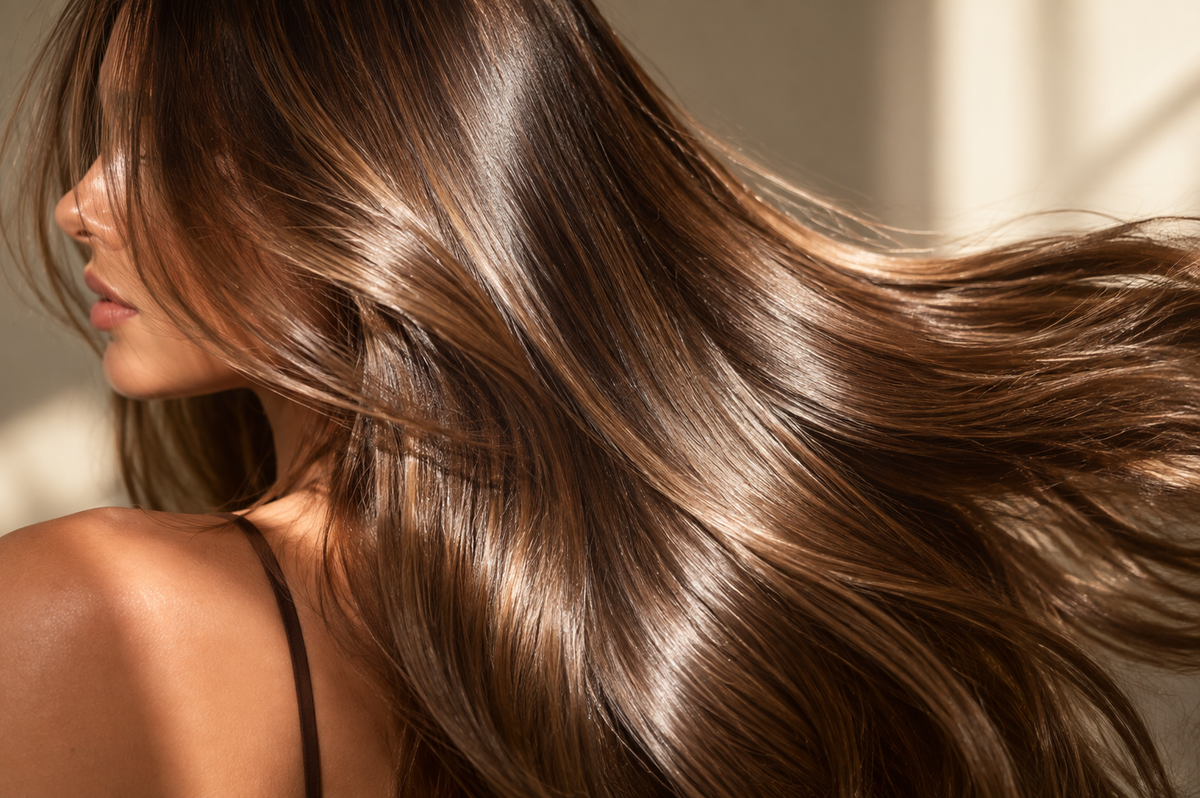

First came glass skin. Now our hair is getting the same treatment.
Scroll for long enough and you'll see it: impossibly glossy lengths, barely a flyaway in sight, with the kind of shine that looks almost liquid. It's called glass hair, and the professionals are already treating it as the defining hair story of the year — colourists and session stylists working backstage and in-salon are naming gloss the service everyone's asking for, not just another product trend spotted on the street.
Here's the good news: it isn't about straightening your hair within an inch of its life. That's the assumption most people make, and it's the wrong one. What actually creates the glass-hair effect is a smooth, well-hydrated cuticle reflecting light evenly along the hair shaft — and that's something you can work towards whatever your natural texture, whether your hair is poker-straight, waved or curly. It's a condition-and-finish trend, not a heat-styling one.
Glass hair vs liquid hair: is there actually a difference?
Not really. Across current coverage, "glass hair," "mirror hair" and "liquid hair" are all being used to describe the same effect — an even, high-shine, reflective finish. You'll see all three terms depending on which publication or creator you're reading, but they're pointing at the same result, not three different techniques. If you're searching for one, the advice for the others applies too.
What actually creates the effect
Shine comes from light reflecting evenly off the hair's outer layer, the cuticle. When the cuticle lies flat and smooth, rather than raised, rough or dehydrated, light bounces off it consistently instead of scattering — and that consistency is what reads as "glassy" rather than just "healthy." Damaged, porous or dry hair scatters light unevenly, which is why no amount of styling can fake true glass hair on hair that isn't in good condition underneath.
That means the real route to glass hair is less about a single finishing product and more about what you do before you get there: repairing damage, restoring hydration, and protecting the cuticle from further wear, before you add any actual shine product on top.
Building a glass-hair routine
This isn't a one-product trend. Getting close to that mirror finish is a five-step build, and each step does a genuinely different job.
1. Repair first. Rough, damaged hair won't reflect light evenly, however much gloss you put on top of it, so this is where any real glass-hair routine has to start. K18's Leave-In Molecular Repair Hair Mask is a four-minute, no-rinse leave-in built around a single patented peptide designed to reconnect damage at a molecular level — an easy first step to fold into a routine you already have, rather than an extra wash-day commitment. If you want to see what else K18 offers for repair-focused routines, the full K18 range is worth a browse. 
2. Hydrate. A flat, reflective cuticle needs moisture behind it. Olaplex's Rich Hydrating Mask is a weekly, in-shower treatment built to replenish dry, thirsty lengths, giving the smooth finish something to actually hold onto rather than fighting dehydrated hair from the outset. Olaplex's full range extends well beyond this one mask, if hydration turns out to be your hair's bigger priority.
3. Smooth and protect. If heat styling is part of how you're getting to glass hair, this step matters more than any of the others — heat is one of the fastest ways to roughen the cuticle you've just spent two steps smoothing. K18's HeatBounce Conditioning Heat Protectant is designed to sit alongside its repair mask for exactly this reason, protecting hair through the styling step rather than after the damage is done.
4. The gloss step.
 This is where a lot of the "glass hair" conversation actually lives, and it's also where people get most confused about the difference between a gloss, an oil and a shine treatment. A gloss works by coating and smoothing the cuticle directly, which is the closest thing to the mirror-finish mechanism itself — different from an oil, which sits on top of hair for shine and softness without necessarily smoothing the cuticle underneath, and different again from a leave-in shine mist, which is lighter still. It's worth choosing which gloss you reach for based on your hair rather than picking at random:
- Kérastase Gloss Absolu Glaze Drops, 45ml — a dropper-applied oil built for precise, controlled use through mid-lengths and ends, good if you want to target specific areas rather than mist all over.
- Redken Acidic Color Gloss Naked Gloss, 100ml — from Redken's colour-gloss line specifically, so it's the one to reach for if you're trying to revive dull, colour-treated hair rather than glossing untreated lengths. Currently low stock, worth checking before you build a routine around it.
- Joico K-Pak Colour Therapy Luster Lock Glossing Oil, 63ml — another colour-focused pick, with a slow-release formula and the most accessible price point here, a sensible place to start if you want to try the gloss step before spending more.
- milk_shake Lifestyling Let It Shine, 200ml — a spray format rather than a dropper or oil, making it the easiest to apply quickly across all-over lengths as part of a daily routine.
5. The finishing step. Olaplex's No.7 Shine Serum Oil Mist is a lightweight, spray-on 2-in-1 finishing step, combining a hydrating serum with weightless oils in a bi-phase mist — designed for instant, hands-off shine and hydration once the rest of the routine is in place. It also carries heat protection up to 232°C, so it can back up step three rather than only working after styling is done. It's the polish on top of the repair and hydration work underneath, rather than a substitute for it.

Does glass hair work on every hair type and texture?
Broadly, yes — the underlying mechanism (a smooth, hydrated cuticle reflecting light) applies whatever your natural texture. What changes by hair type is how far towards a fully "glass" finish you'll get, and how much of the emphasis should sit on hydration versus smoothing. Curlier and coilier textures naturally have more cuticle layers and bends along the hair shaft, which scatters light more even at their healthiest, so a realistic goal is a noticeably glossier, smoother version of your own texture rather than a poker-straight finish — the routine above still applies, just without any expectation that curly hair needs to look straight to look "glass."
The allbeauty glass hair edit

If you're building this routine from scratch rather than adding one product to what you already own, here's a considered starting range across the five steps above, spanning most budgets:
- K18 Leave-In Molecular Repair Hair Mask, 50ml — the repair step, and the one to prioritise first if you're only adding one new product
- Olaplex Rich Hydrating Mask, 200ml — weekly hydration, especially useful going into autumn as indoor heating dries hair out further
- K18 HeatBounce Conditioning Heat Protectant — non-negotiable if heat styling is part of getting the look
- Joico K-Pak Colour Therapy Luster Lock Glossing Oil, 63ml — the most affordable way into the gloss step, and a good pick if your hair is colour-treated
- milk_shake Lifestyling Let It Shine, 200ml — an easy, spray-format gloss for quick daily use
- Redken Acidic Color Gloss Naked Gloss, 100ml — a colour-focused gloss oil, currently low stock
- Olaplex No.7 Shine Serum Oil Mist — the finishing step, with heat protection built in
- Kérastase Gloss Absolu Glaze Drops, 45ml — listed as a bestseller on allbeauty's own Gloss Absolu range, and the best choice here for targeted, precise application
You don't need to buy into all five steps at once, and you certainly don't need four different glosses. Repair and hydration do the most structural work, so they're the sensible place to start if you're building this gradually, then add one gloss and the finishing mist once you know which format you prefer.
Is it worth it, compared to a salon gloss?
Building the full five-step routine from scratch, buying one of each product above, costs somewhere between £167.60 (choosing the Joico oil as your gloss) and £184.60 (choosing the Kérastase Glaze Drops) — full price for all five steps, before any allbeauty savings are applied. A single in-salon gloss treatment starts from £61 at Rush Hair & Beauty, one of the UK's larger salon chains, for around an hour's appointment.
That makes the at-home route look like the bigger spend on paper, but it isn't really a fair like-for-like comparison. A salon gloss is one treatment that fades and needs booking again every few weeks. The at-home routine is five products that each last for weeks of repeat use, not one sitting, and you don't need to rebuy the repair mask, hydrating mask or heat protectant nearly as often as the gloss and finishing steps. If you're chasing the look once for an event, a single salon booking is the simpler option. If you're maintaining it as part of your actual routine, building the at-home version is the better value over time, even with the higher price on day one.
Behind every product on this list is a buying team whose job is to go and find it: tracking down the haircare brands and formulations worth stocking, from established names like K18, Olaplex and Kérastase to newer arrivals like Joico and milk_shake, and working to bring them to you at a genuinely competitive price rather than the full asking rate. It's the same approach across everything allbeauty stocks, from skincare to fragrance, so once your glass-hair routine is sorted, it's worth seeing what else is waiting for you.
Explore the full haircare range at allbeauty to start building your glass-hair routine.
FAQs
What is glass hair? Glass hair is the term for an exceptionally smooth, mirror-like hair finish, created by a smooth, well-hydrated cuticle reflecting light evenly along the hair shaft. It's also referred to as mirror hair or liquid hair — different names for the same effect.
Is glass hair the same as liquid hair or mirror hair? Yes, in practice. All three terms are currently used interchangeably to describe the same high-shine, reflective finish.
Do I need straight hair to get glass hair? No. The mechanism behind glass hair — a smooth, hydrated cuticle — applies across hair textures. Curlier and coilier hair will naturally scatter more light than straight hair even at its healthiest, so the realistic goal is a glossier, smoother version of your own texture rather than a straightened finish.
What's the difference between a hair gloss, a hair oil and a shine serum? A gloss coats and smooths the cuticle directly, which is the closest match to the glass-hair mechanism itself. A hair oil adds shine and softness on top of hair without necessarily smoothing the cuticle underneath. A shine serum or mist, like a finishing spray, is typically the lightest of the three, adding polish as a final step rather than doing the structural smoothing work.
How often should I use a gloss to maintain glass hair? At-home gloss oils and drops, like the ones in this routine, are designed for regular use as part of your normal wash and style routine, rather than as an occasional treatment — check the specific product's own instructions for exact guidance, since formulas vary. That's different from an in-salon gloss treatment, which is applied less often and typically needs repeating every few weeks as it fades.
How long does it take to get glass hair? There's no fixed timeline, since it depends on your hair's starting condition. Repair and hydration steps generally need consistent use over several weeks to improve the hair's underlying condition, while gloss and finishing steps can add visible shine immediately.


